Camargue horses, endless lavender fields, timeless villages - Explore the South of France through your lens.
Best Camera Settings for Photographing Camargue Horses
Discover the best camera settings for horse photography in the Camargue, shutter speed, autofocus, burst mode, ISO, aperture, and panning, scenario by scenario.
PHOTO TIPSCAMERA SETTINGS
Patrice Aguilar
7/8/20269 min read
What you will find in this article :
Introduction
Quick reference : Starting settings by Scenario
Shutter Speed for Horse Photography : Freezing the Gallop
Autofocus Settings for Horses : Continuous vs. Single
Burst Mode : Why Frame Rate Wins the Shot
ISO Settings for Horse Photography
Aperture Settings for Horse Photography
Camera Settings by Scenario
Bringing It All Together
Frequently Asked Questions


Introduction
A galloping herd bursting through golden water at sunrise is one of the most thrilling sights in wildlife photography, and one of the easiest to ruin with the wrong settings. Even with the Best Gear, a blurry mane or a missed focus lock can turn a once-in-a-lifetime moment into a deleted file.
This guide breaks down the best camera settings for horse photography in the Camargue, scenario by scenario, so you're never fumbling with your dials when the herd finally moves. If you haven't already, start with our Ultimate Guide to Photographing the White Horses of the Camargue for the bigger picture, this article goes deep on the technical settings alone. You could also have a look to our article : Best Time of Year to Photograph the White Horses of the Camargue.


Quick reference : Starting settings by Scenario
Bookmark this table. It's not a substitute for understanding why, that's what the rest of the article is for, but it's a solid starting point to dial in fast when the light is changing and the horses aren't waiting.


Now let's look at each setting individually, and why it changes so much from one situation to the next.
Shutter Speed for Horse Photography : Freezing the Gallop
Shutter speed is the single most important setting when it comes to horse photography, and it's the one that separates a tack-sharp gallop shot from a frustrating blur.
A horse at full gallop can cover ground at 40–48 km/h (25–30 mph), and its legs and mane move even faster than that. To freeze this motion cleanly :
1/2000s to 1/4000s is the sweet spot for a horse at a full gallop, especially when it's moving across your frame (the fastest kind of motion to capture) rather than toward you.
1/1000s to 1/1600s is usually enough for a trot, a walk, or a horse moving mostly toward or away from the camera.
1/500s to 1/800s works fine for calmer portraits or standing horses, where there's little to no motion to freeze.
The one major exception is panning, which deliberately uses a slow shutter speed; more on that below.
One practical note for the Camargue specifically : light changes fast around sunrise and sunset, which is exactly when horses are most active. Don't set your shutter speed once and forget it, check your histogram regularly, especially as the sun climbs.


Autofocus Settings for Horses : Continuous vs. Single
Choosing the right autofocus mode is just as critical as shutter speed, and it depends entirely on whether your subject is moving.
AF-C (Continuous AF, called AI Servo on Canon) should be your default for almost all Camargue horse photography. It continuously adjusts focus as the horse moves toward, away from, or across your frame, essential for galloping herds, foals at play, or any horse that might suddenly bolt.
AF-S (Single AF, called One-Shot on Canon) locks focus once and holds it, which only makes sense for genuinely static subjects : a horse standing still for a portrait, or a gardian posing calmly for a moment. The risk with AF-S is that if the horse moves even slightly after you lock focus, your shot is out of focus with no second chance.
A few additional tips that make a real difference:
Enable animal eye-detection AF if your camera has it (most modern mirrorless bodies do). It dramatically increases your keeper rate on portraits and slower action.
Use wide-area or zone AF for fast, unpredictable action like horses fighting or splashing through water, where a single focus point is too easy to lose.
Switch to a single, smaller AF point for more deliberate compositions, like a silhouette against the sunset, where you need to control exactly what's sharp.

Burst Mode : Why Frame Rate Wins the Shot
Horse photography is a game of fractions of a second. The moment a hoof breaks the water's surface, or a mane flares out mid-stride, lasts a tiny fraction of a second, and burst mode is what gives you a real chance of catching it.
Shoot in your camera's highest available continuous mode for any action sequence, water, dust, rearing, fighting. Most modern mirrorless cameras now offer 15 to 30+ frames per second, which turns a single gallop past you into dozens of frames to choose from.
Two things to keep in mind:
Your memory card needs to keep up. A slow card causes your buffer to fill and your burst rate to stall right when you need it most, we cover this in detail in What Camera Gear Should You Bring to a Camargue Photography Workshop
Burst mode isn't just for action. Even for portraits, a short low-speed burst (3–5 fps) helps you catch the exact moment a horse's ear flicks forward or its head turns just right.
ISO Settings for Horse Photography
ISO is your safety valve, the setting you raise only after shutter speed and aperture are locked in for the shot you want. In the Camargue, where the best light happens at dawn and dusk, you'll often need to push ISO higher than you would at midday.
ISO 100–400: bright daylight, or portraits where you have full control of your settings.
ISO 400–1600: the "workhorse" range for most sunrise and sunset action, when light is lower but you still need a fast shutter speed to freeze motion.
ISO 1600–3200 (or higher): pre-dawn or heavily overcast conditions, or fast-moving action in dusty, low-contrast light.
Modern cameras handle high ISO remarkably well, and a slightly noisy but sharp photo will almost always beat a clean but blurry one. When in doubt, prioritize shutter speed and accept the ISO increase, noise can be reduced in post-processing ; motion blur usually can't be fixed.

Aperture Settings for Horse Photography
Aperture controls two things at once : how much light reaches your sensor, and how much of your scene is in focus (depth of field). Your choice depends heavily on the type of shot.
Wide apertures (f/2.8–f/4) isolate your subject with a soft, blurred background (also called Bokeh), ideal for portraits and foals, where you want the horse's eye to be the undeniable focal point.
Moderate apertures (f/4–f/8) are the standard choice for action : fast enough to let in plenty of light for a high shutter speed, while still giving you a slightly larger margin for focus error on a fast-moving subject.
Narrow apertures (f/8–f/16) come into play for silhouettes and panning shots, where you want more of the scene in focus, the whole herd sharp, or a clean, defined shape against the sky.
For lens recommendations that match these apertures in real-world Camargue conditions, see our guide to the best lenses for photographing the white horses of the Camargue.
Camera Settings by Scenario
General rules only go so far, the Camargue throws genuinely different lighting and motion challenges at you within the same morning. Here's how to adapt for each one.
Horses in Water (Action)
Water scenes are the signature shot of the Camargue : horses bursting through lagoons in a wall of spray. Use a fast shutter speed (1/2500–1/4000s) to freeze individual water droplets rather than letting them blur into a smear. Combine this with AF-C and animal-eye AF if available, horses in water tend to move unpredictably as they react to the splash. Watch your exposure carefully : bright water and spray can fool your camera's metering into underexposing the horses themselves, so don't be afraid to dial in some positive exposure compensation.
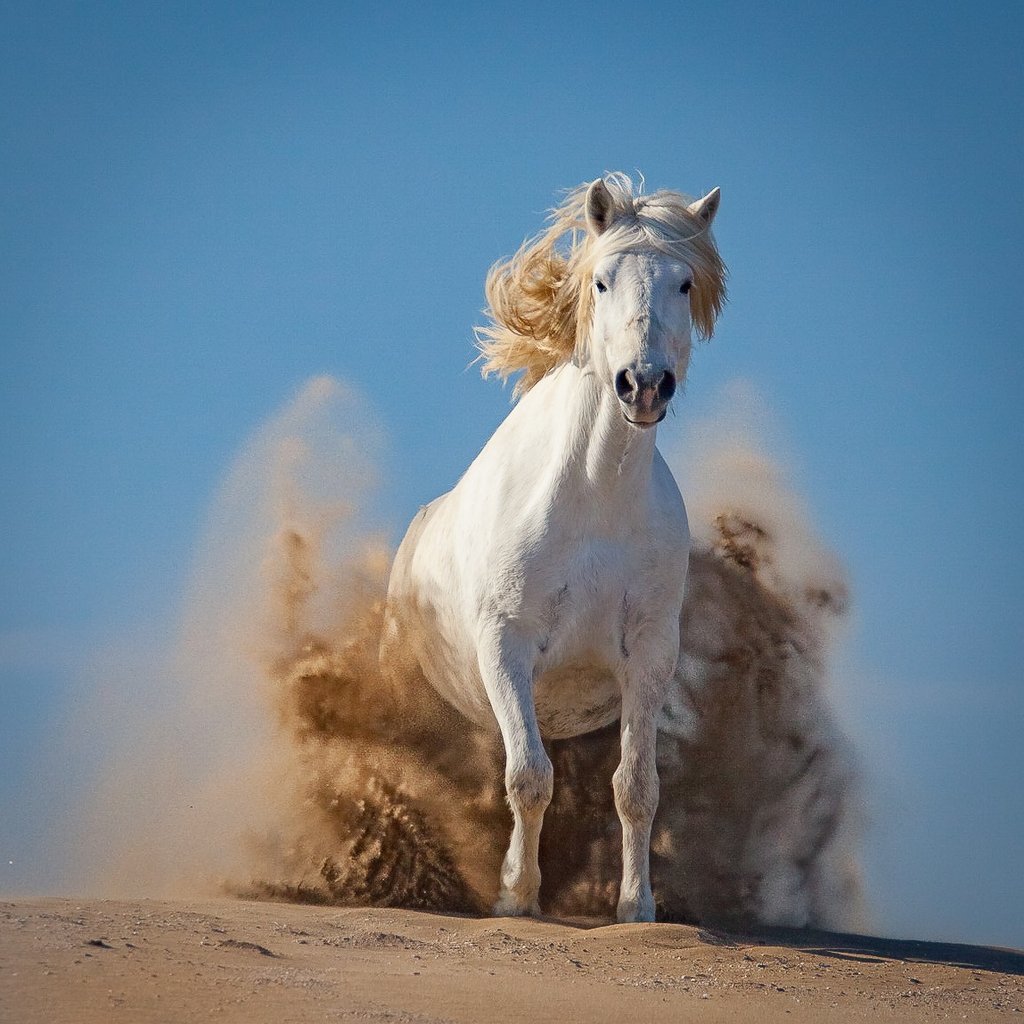
Horses in Dust (Action)
Dust scenes, more common in summer and autumn, create a completely different mood, warm, hazy, atmospheric. The core settings are similar to water shots (fast shutter, continuous AF), but two things change : contrast and clarity drop in dusty air, so autofocus can hunt more ; switching to a wider AF zone helps. ISO often needs to run higher too, since dust scatters and softens the light. For more on how the changing seasons affect these conditions, our guide on wildlife photography in the Camargue covers horses, flamingos, and the wetlands in more depth.
Portraits
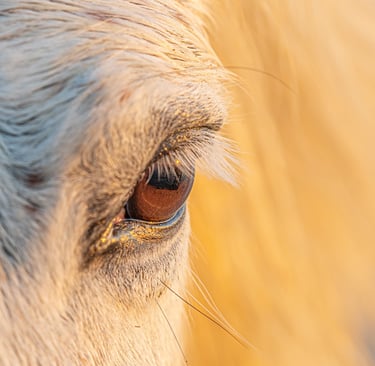
Slow down for portraits. A wide aperture (f/2.8–f/4), a moderate shutter speed (1/500–1/1000s), and single-point AF placed precisely on the eye will consistently outperform action settings here. Get low, at the horse's eye level, for the most compelling result.
Foals
Foals move erratically and unpredictably, playful bursts of speed followed by sudden stillness. Keep AF-C engaged at all times, use a slightly faster shutter speed than you would for an adult portrait (1/1000–1/2000s), and stay ready with a medium burst rate. Patience matters more than settings here : the best foal shots come from waiting for the moment, not chasing it.
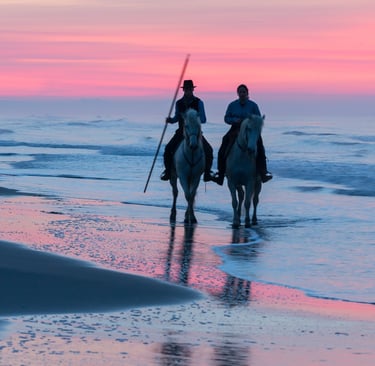
Silhouettes at Sunrise and Sunset (Backlight)
Shooting directly into the sun demands a different approach entirely. Close down your aperture (f/8–f/11) for a crisp, well-defined silhouette, and expose for the sky rather than the horse, this is what turns the animal into a clean black shape against vibrant color. Switch your camera to spot metering on the sky itself, or use manual exposure once you've found a setting you like, since backlit scenes routinely confuse automatic metering. Our article on sunrise photography in the Camargue goes further into reading and using this light.
Panning Photography for Horses
Panning is the technique of using a slow shutter speed while physically tracking a moving horse with your camera, blurring the background into streaks of motion while keeping the horse relatively sharp. It's one of the most creative, and most difficult, ways of photographing horses running.
Use a slow shutter speed, typically 1/20s to 1/125s depending on the horse's speed and how much blur you want.
Set a narrow aperture (f/8–f/16) and low ISO (100–200) to avoid overexposing at such a slow shutter speed.
Keep AF-C engaged and track the horse smoothly with your whole upper body, not just your arms, following through past the shutter click just as you would in golf or tennis.
Expect a low hit rate. Panning is a numbers game, shoot in bursts, and don't be discouraged if only one in ten frames nails the sharpness-versus-blur balance.
Panning takes practice, and the Camargue, with its open beaches and long, straight stretches where horses run parallel to the shore, is one of the best places in the world to learn it.


Bringing It All Together
The truth about camera settings for horse photography is that no single combination works for the whole day. Light, motion, and subject change from one minute to the next in the Camargue, and the photographers who come home with the strongest galleries are the ones who adjust constantly rather than setting their dials once at sunrise and forgetting them.
If you're heading out on your own, review our 10 Essential Tips Before Photographing the White Horses of the Camargue and double-check your kit against The Ultimate Camargue Photography Packing List before you go.
And if you'd rather have someone reading the light and the herd for you, leaving you free to focus purely on your settings and your framing, that's exactly what a guided workshop offers. Take a look behind the scenes of a Camargue horse photography workshop to see what a day in the field actually looks like, or check our upcoming spring and autumn dates.
Frequently Asked Questions
What is the best shutter speed for horse photography ? For a horse at full gallop, 1/2000s to 1/4000s reliably freezes motion. Slower subjects, like a walking or standing horse, only need 1/500s to 1/1000s.
Should I use continuous or single autofocus for horses ? Continuous AF (AF-C or AI Servo) should be your default for almost any horse photography, since horses rarely stay perfectly still. Single AF (AF-S / One-Shot) is only reliable for genuinely static subjects, like a calm portrait.
What ISO should I use for horse photography ? Start as low as your light allows, ISO 100–400 in bright conditions, and raise it as needed to maintain a fast shutter speed, especially at sunrise or sunset when ISO 800–1600 is often necessary.
What shutter speed should I use for panning photography of horses ? Panning typically uses a much slower shutter speed than freezing action, usually between 1/20s and 1/125s, combined with tracking the horse's movement smoothly with your camera.
PixterraJourneys
Field-craft and photo storytelling in Southern France.
Join us
contact@pixterra.fr
Gignac la Nerthe, Provence, France
Booking open for Autumn, Spring & Summer
© 2026 PixterraJourneys - Selected regional access options for passionate photographers.
Provence & Camargue